What is Sovereign Computing
Sovereign computing is infrastructure you control - running on hardware you own or trust, built entirely from open source components, sovereign by design rather than by policy.
It is not a cloud service with a data residency guarantee. It is not a vendor's managed platform with a sovereignty label. It is foundation infrastructure - the layer beneath your applications - that operates on your terms, in your jurisdiction, under your control.
The definition
Sovereign computing infrastructure, as defined by this initiative, is a coherent, integrated set of open source components that together deliver the foundation services any organisation needs to run digital workloads independently.
Core capabilities
- Compute, Storage, and Network as a Service
- Elastic, programmable infrastructure equivalent to what a hyperscaler provides, running on commodity hardware under your control.
- High Availability and Business Continuity
- Redundancy and disaster recovery built in, not bolted on. Backup is a means to an end.
- Identity and Access Management
- Single sign-on and machine-to-machine authentication. Whoever controls identity controls the stack - so identity must be yours.
- Zero Trust Security
- Encryption in motion and at rest as a baseline. Secrets management. Perimeter and segmentation controls.
- Centralised Logging
- For diagnostics, performance, security audit, and compliance - in one place, from day one.
- Automated Operations
- Programmatic install, upgrade, and update. Operable without deep specialist expertise.
- Portable Workloads
- No lock-in to proprietary formats or interfaces. Data and workloads move freely.
How it fits together
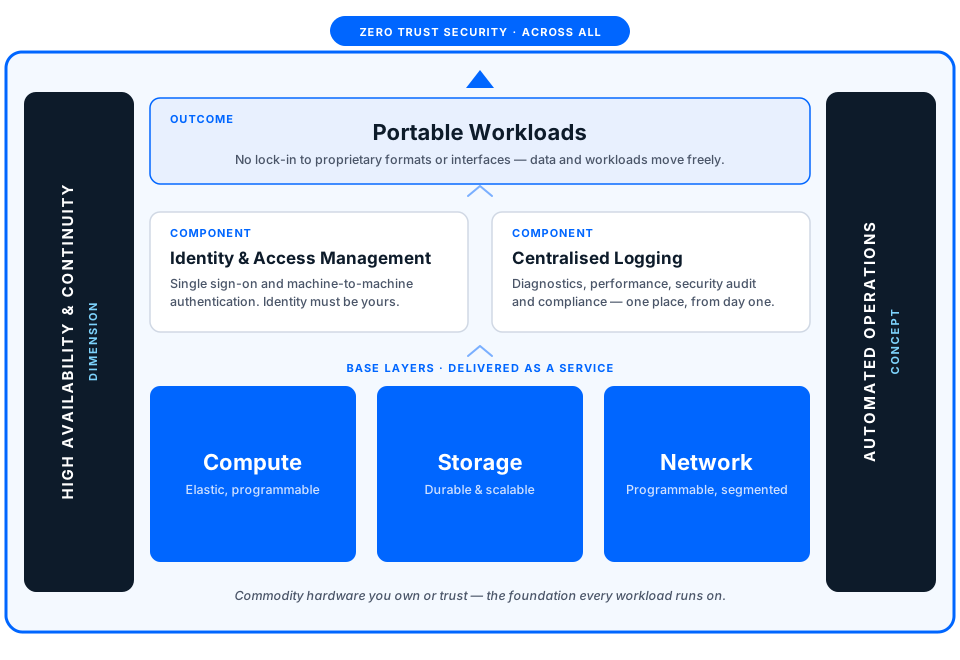
The core capabilities are not a checklist - they form a single, coherent architecture. Compute, storage and network as a service are the base layers; identity and centralised logging are component blocks above them; high availability and automated operations run as dimensions across every layer; zero trust wraps the whole; and portable workloads are the outcome.
What it is not
Sovereign computing infrastructure explicitly excludes hardware, end-user applications (productivity, collaboration, office tools), traditional platform services such as database-as-a-service, and any single vendor's proprietary solution. These sit above or below the category, not within it.
Sovereign by design
The word sovereign carries specific meaning here. Infrastructure is sovereign when:
- it runs on hardware you own or that is dedicated to you
- your environment is not shared with others at the hardware level
- zero trust is a design principle, not a configuration option
- data is encrypted at rest and in transit as a baseline
- data can be freely exported and imported in standardised formats
Sovereignty is an architectural property, not a contractual one.
The conformance framework
A coherent category requires agreed conformance criteria - a shared definition of what qualifies and what does not. The Sovereign Computing Initiative is developing that framework collaboratively, drawing on existing standards including the Sovereign Cloud Stack, OpenSSF best practices, NIS2, and the Cyber Resilience Act.
The conformance framework will be open, community-governed, and usable directly in procurement. See how conformance works and the Sovereignty Test, the support model it tests, and the Mark it produces.
Optional capability extensions
Beyond the core, the category accommodates optional capability stacks for organisations with specific needs: an AI Stack for inference and model serving, a DevOps Stack for CI/CD and development tooling, a Software Platform for Kubernetes and runtime services, and a Productivity Stack for office and collaboration tools.
These extensions are additive. The core remains minimal, coherent, and independently operable.
Why it matters
Understanding what sovereign computing is leads naturally to why it is worth the effort. For the case - dependency risk, lock-in, exit by design, and the regulatory context - see why sovereign computing.